
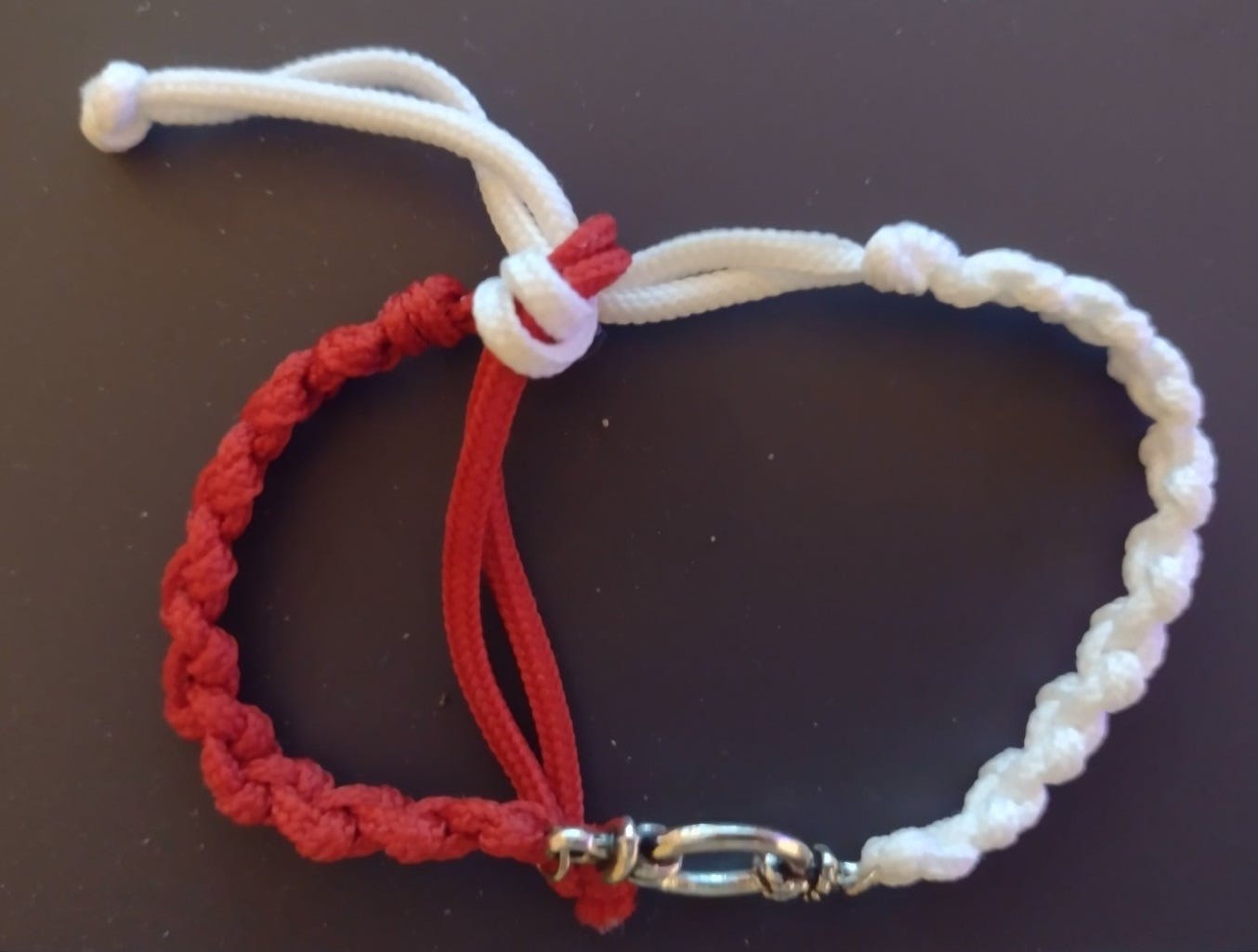
Every year, on March 1st, Chinese factories specialised in the fast, low-cost production of a special sort of accessories reap the fruit of their labour as six million Bulgarians exchange red-and-white bracelets, badges, and brooches in celebration of the first day of March and the coming spring.
Баба Марта, or Granny March, is the embodiment of the month, also called “the female month” but not because of March 8th, which we also celebrate, thank you very much. It’s because of the weather, which is traditionally believed to be extra fickle compared to other months, which is of course very rude, misogynistic, patriarchal, and also anti-feminist, I’m sure. It is also quite true. March is fickle. March has mood swings. And we just bought 10 kg of seed potatoes and are hoping for the best while it’s 0 degrees outside, with a side order of fog. The forecast was for a sunny day with max temperatures of 12 degrees.
But back to Баба Марта and the мартеница, which has no equivalent in other cultures, so it doesn’t get translated but simply transliterated as martenitsa. Legend has it that the founder of Bulgaria, Khan Asparuh, had some trouble with the Khazars who kidnapped his sister. Rescue operation planning ensued, the plan was set in motion, the sister escaped and to inform her brothers (there were a total of five) of the successful outcome, because they were not personally present there, she sent a bird.
Variations of the story disagree on the bird species — a dove or a falcon — but they agree on the thread tied to the bird’s leg. It was white, signifying the success of the mission. On its way, however, the bird got shot with an arrow by the Khazars, an incident resulting in the partial colouring of the white thread with blood. For the more detailed story, machine translate from here.
Since then, the martenitsa has become a symbol of health, good luck (always with the luck) and the start of a new annual cycle of renewal. That’s why on March 1st we give each other martenitsi (-i is the most common plural noun ending in Bulgarian) and say Happy Granny March, which sounds ridiculous in English because I couldn’t come up with a better translation. Funnily enough, Romanians also celebrate a version of Granny March, but they only give martenitsi to women, which was what Bulgarians also did originally, historians claim.
Tradition says you should wear a martenitsa until you see a tree in bloom, when you should take the martenitsa off and hang it on a branch, both for your own good health and the tree’s. Right here, right now, this means I can take off the martenitsa Cris gave me immediately, because our almond trees are starting to bloom. Almond trees are not known for their patience. Trees in areas with heavy foot traffic tend to acquire vibrant white-and-red decorations in March.
An alternative for those who enjoy wearing their white-and-red accessories for longer is to keep them on until they see a stork, since the return of storks is another sign that warm weather is also returning. Essentially, the martenitsa is yet another symbol of hope for better days, though this year there is little cause for such hope, at least geopolitically speaking. Climatically speaking, spring always comes. Честита Баба Марта!
I’m enjoying the color of the traditions in your culture. Some traditions should never end, others should. Such is the evolution of our societies.
That's a whole lot of seed potatoes.